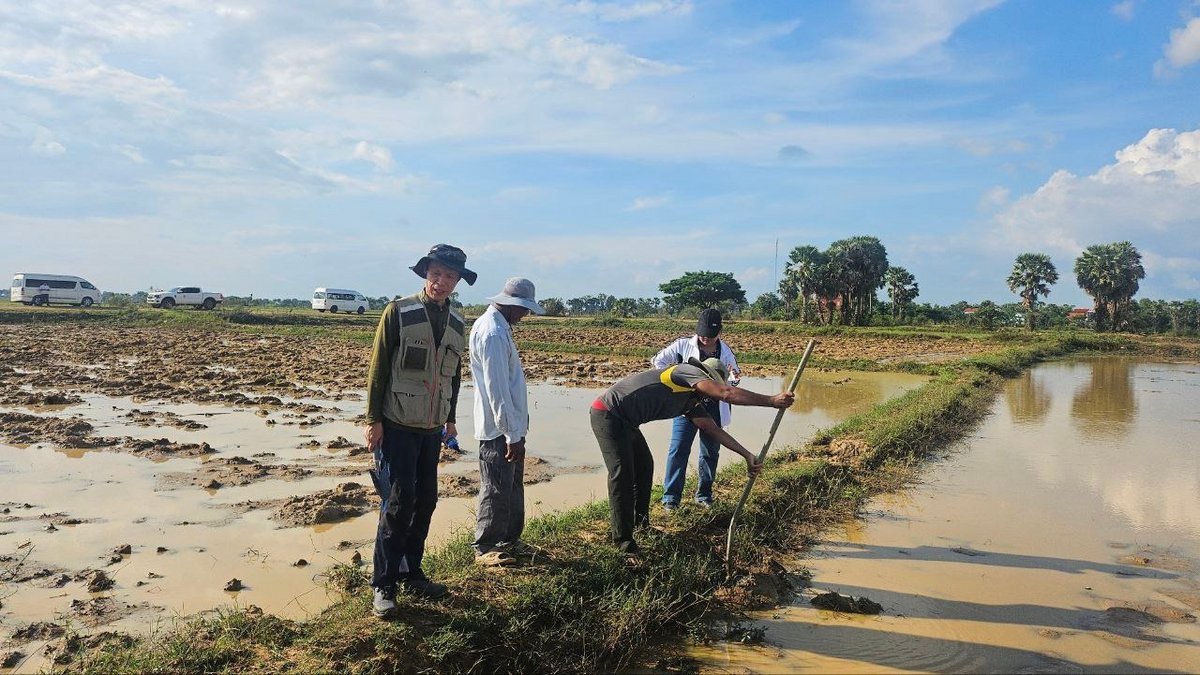
Agriculture and waste are among the largest sources of methane emissions in Cambodia.
Rice cultivation, practiced mainly under continuously flooded conditions, generates methane through anaerobic soil processes, while rapid urbanisation has increased methane emissions from open dumping and unmanaged landfills. Without targeted interventions, emissions from both sectors are expected to rise.
Cambodia’s Nationally Determined Contribution identifies agriculture and waste as priority mitigation sectors(1), and the country is a signatory to the Global Methane Pledge. In this context, practices such as Alternate Wetting and Drying (AWD) in rice farming and improved solid waste management offer proven, cost-effective mitigation options
The ASEAN–Korea Cooperation Fund supports Cambodia in advancing methane mitigation through regional cooperation, technical assistance, and capacity building.
(1) Cambodia NDC
As per Cambodia’s Methane Reduction Roadmap published in 2025, methane emissions in the country had increased by more than 100% between 1994 and 2023. In 2023, the agriculture sector, primarily rice cultivation and livestock, accounted for more than 80% of total methane emissions, making it the dominant source. The waste sector was the second largest contributor to overall methane emissions (1).
(1) BTR, 2024
Here's a visual representation of estimated methane emissions in Cambodia.
Increasing attention is being given to methane (CH₄), a short-lived but highly potent greenhouse gas with a global warming potential nearly 28 times greater than that of CO₂.
For Cambodia, this growing focus is particularly relevant, as the country has demonstrated strong commitment by being among the early signatories to the Global Methane Pledge and by establishing enabling policies such as the Methane Reduction Roadmap to support this transition. Agriculture (rice and livestock) and waste are the main sources of methane emissions in Cambodia, with rice cultivation playing a particularly significant role. (Methane Reduction Roadmap for Cambodia, 2025)
However, a clear implementation plan to translate the roadmap into action remains limited, and the need to strengthen methane Monitoring, Reporting, and Verification (MRV) systems is becoming increasingly evident.
In response, the AKCMM project in Cambodia is adopting a targeted approach by prioritizing the agriculture sector and designing interventions to identify mitigation technologies and their potential in rice cultivation, improve methane MRV for rice and livestock waste, and assess the feasibility of Alternate Wetting and Drying (AWD) practices in the country.